


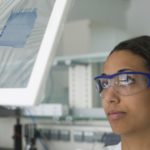
Forensic chemists analyze non-biological trace evidence found at crime scenes in order to identify unknown materials and match samples to known substances. They also analyze drugs/controlled substances taken from scenes and people in order to identify and sometimes quantify these materials.
Working in a lab, they run tests on samples collected by investigators. They use a variety of techniques, including microscopy, optical analysis (such as UV, infrared, X-ray), gas chromatography and other technologies. They carefully document their findings and write reports that are used to support criminal investigations. Forensic chemists may also testify to their findings in court.
Working Conditions
Forensic chemists usually work in a laboratory setting, often as employees of local, state or federal government. They often stand or sit for long periods of time, perform repetitive tasks and use highly technical equipment.
They must follow strict procedures regarding the handling and documentation of evidence, as well as scientific protocols to ensure the quality and reliability of tests and equipment.
The pressure from law enforcement personnel to speed results can be intense, so the forensic chemist must be able to prioritize well and work efficiently while ensuring that the results are accurate.
Testifying in court requires strong communication skills, including the ability to remain calm in the face of cross-examination and explain complex scientific procedures in a manner juries can understand.
Academic Requirements
A forensic chemist generally has a bachelor’s degree in chemistry, clinical chemistry or another related scientific field. Some universities now offer master’s degrees and even doctoral (Ph.D.) degrees in forensic chemistry.
Be sure any program you choose is accredited by the Forensic Science Education Programs Accreditation Commission (FEPAC).
Preparation Timeline
In High School
- Take advanced science courses, including AP chemistry and biology.
- Join the debate team to master the art of public speaking.
- Participate in sports to learn teamwork.
- Do a science fair project that uses the techniques of forensic chemistry in a creative way.
- Construct scale models to hone your fine motor skills and learn patience.
In College
- Major in chemistry.
- If you are enrolling in a forensic science program, make sure the program requires at least 24 semester hours of chemistry and math.
- Take elective courses in law enforcement, criminal justice and crime scene processing.
After College
- Consider getting a master’s degree in forensic science. They are increasingly required to qualify for jobs in certain jurisdictions. Look for a program that emphasizes laboratory science and research, with coursework in crime scenes, physical evidence, ethics and quality assurance as well as interaction with working forensic laboratories.
- Make sure to continue your education throughout your career. It will be required in most jobs.
Resources
- American Academy of Forensic Sciences
- American Association for Clinical Chemistry
- American Chemical Society
- AOAC INTERNATIONAL
- The International Association of Forensic Toxicologists
- Society of Forensic Technologists